GPS tracking for small business, controlling operating costs is essential for maintaining healthy profits. When a business depends on cars, vans, delivery vehicles, service vehicles, or other commercial vehicles, fleet expenses can quickly become a significant part of the monthly budget.
Fuel consumption, vehicle maintenance, driver overtime, unnecessary trips, excessive idling, unauthorized vehicle use, and unexpected breakdowns can all increase costs. The challenge is that many of these expenses are difficult to identify when vehicle activity is managed through phone calls, paper records, fuel receipts, or spreadsheets.
This is where GPS tracking for small business fleet expenses can make a practical difference.
A modern GPS tracking system does more than show where a vehicle is located. It provides useful information about routes, distance travelled, stops, idle time, vehicle movement, and driving behaviour. When businesses use this information correctly, they can identify avoidable expenses, improve fleet efficiency, and make better operational decisions.
The objective is simple: understand how your vehicles are being used, identify unnecessary costs, and take action to control them.
What Are Fleet Expenses for a Small Business?
Fleet expenses include the direct and indirect costs involved in operating business vehicles.
Common fleet expenses include:
- Fuel and energy costs
- Vehicle servicing and maintenance
- Driver salaries and overtime
- Insurance and documentation
- Tyres and replacement parts
- Unexpected repairs
- Parking and toll expenses
- Vehicle downtime
- Unnecessary mileage
- Delayed deliveries
- Excessive idling
- Unauthorized vehicle usage
Some of these costs are unavoidable. However, others are created by inefficient fleet operations.
For example, a delivery vehicle that regularly travels extra kilometres, remains idle for long periods, or makes unnecessary trips can consume more fuel and require more maintenance without generating additional business value.
A GPS tracking system can help make these activities visible.
How GPS Tracking Helps Control Fleet Expenses
GPS tracking collects vehicle activity data and presents it through a web or mobile-based platform. Depending on the system, businesses can monitor live location, trip history, routes, mileage, stops, idle time, speed, geofencing events, and other fleet activities.
This information can help small businesses identify where their fleet budget is being used and where improvements may be possible.
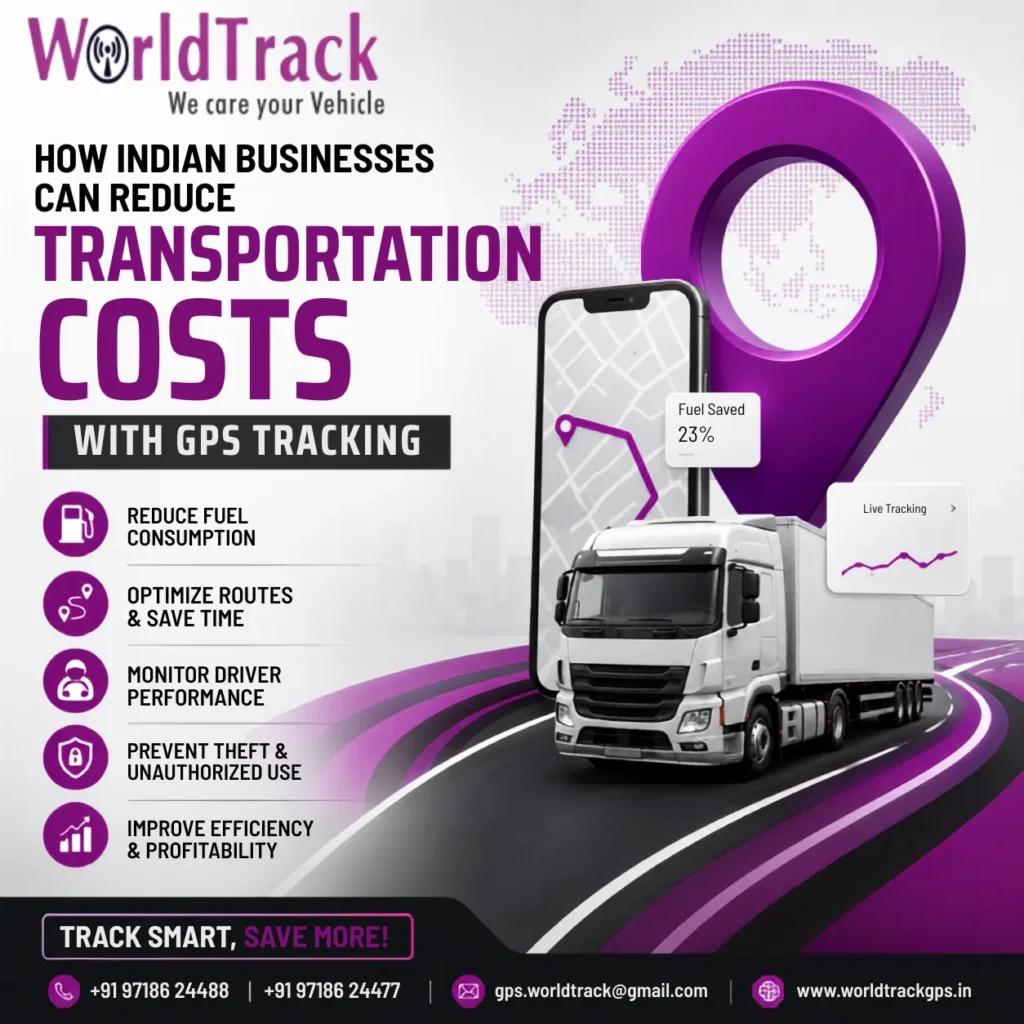
1. Reduce Unnecessary Fuel Consumption
Fuel is often one of the largest recurring expenses for businesses operating multiple vehicles.
GPS tracking can help identify activities that may contribute to unnecessary fuel usage, including:
- Unnecessary trips
- Longer-than-required routes
- Excessive idling
- Frequent detours
- Unauthorized vehicle use
- Aggressive driving
- Excessive mileage
For example, if a delivery vehicle normally covers around 100 kilometres per day but tracking reports show that it regularly travels 125 kilometres for similar work, the business can investigate the reason.
The additional distance may be caused by poor route planning, unnecessary stops, traffic conditions, or unauthorized use.
Once the cause is understood, the business can take corrective action.
2. Control Excessive Vehicle Idling
A vehicle can continue consuming fuel while the engine is running even when the vehicle is stationary.
Drivers may leave vehicles running while waiting for customers, loading goods, taking breaks, or completing other tasks. One incident may seem insignificant, but repeated idling across several vehicles can increase monthly fuel expenses.
A GPS tracking system with idle-time monitoring can help identify vehicles that regularly spend excessive time stationary.
Businesses can then:
- Identify high-idling vehicles.
- Understand why the idling occurs.
- Discuss recurring issues with drivers.
- Introduce practical idle-time policies.
- Monitor whether the situation improves.
This turns an otherwise hidden expense into a measurable fleet-management issue.
3. Improve Route Planning and Reduce Unnecessary Mileage
Poor route planning can increase fuel consumption, driver working hours, vehicle wear, and delivery times.
GPS tracking provides historical route information that helps businesses understand how vehicles actually travel during daily operations.
A delivery company, for example, may discover that its drivers are regularly taking longer routes or making unnecessary detours.
By reviewing this information, management can improve route planning and scheduling.
For service businesses with technicians visiting multiple customers, GPS data can also help managers understand whether vehicle assignments are efficient.
Better planning may allow the business to complete more work with its existing fleet instead of immediately adding another vehicle.
4. Reduce Unauthorized Vehicle Usage
Business vehicles are valuable company assets, and unauthorized use can increase fuel consumption, mileage, maintenance requirements, and vehicle wear.
GPS tracking allows businesses to review vehicle movement and trip history.
If a vehicle is regularly operating outside approved working hours or locations, management can investigate the reason.
The purpose should not be to micromanage drivers. Instead, businesses should establish clear vehicle-use policies and use GPS data to improve accountability and protect company assets.
5. Improve Driver Behaviour
Driver behaviour can have a direct effect on fuel consumption, vehicle wear, maintenance costs, and safety.
Depending on the GPS tracking solution, businesses may be able to monitor events such as:
- Overspeeding
- Harsh acceleration
- Sudden braking
- Excessive idling
- Aggressive driving patterns
This information can help managers identify repeated issues and provide appropriate driver training.
For example:
GPS data identifies repeated overspeeding → management reviews the pattern → driver receives guidance → behaviour improves → vehicle operation becomes safer and potentially more efficient.
Using data this way is more effective than relying only on assumptions or occasional driver complaints.
6. Improve Vehicle Maintenance Planning
Unexpected vehicle breakdowns can be expensive for a small business.
Apart from repair costs, a breakdown can result in:
- Missed deliveries
- Customer complaints
- Driver downtime
- Lost working hours
- Emergency repair expenses
GPS tracking for small business can not replace proper vehicle maintenance, but mileage and usage information can support a more organized maintenance process.
Businesses can use vehicle activity data alongside manufacturer recommendations and existing maintenance records to plan servicing more effectively.
Regular maintenance can help reduce the risk of avoidable breakdowns and keep vehicles available for business operations.
7. Identify Suspicious Fuel and Vehicle Activity
Fuel theft and unexplained fuel loss can be difficult to investigate when businesses rely only on receipts and manual records.
GPS tracking can help identify unusual activity such as:
- Unexpected stops
- Unusual routes
- Vehicle movement outside business hours
- Repeated unexplained trips
- Significant differences between expected and actual vehicle usage
For businesses that require more detailed fuel monitoring, GPS tracking can be combined with compatible fuel-level monitoring technology.
However, unusual GPS activity should be treated as a reason for investigation rather than automatic proof of theft. Businesses should verify the circumstances before taking action.
8. Improve Fleet Utilization
Small businesses often assume that they need additional vehicles when demand increases.
Before purchasing another vehicle, it is useful to understand how effectively existing vehicles are being utilized.
GPS reports can help answer questions such as:
- Which vehicles are used most frequently?
- Which vehicles travel the highest number of kilometres?
- Which vehicles remain inactive for long periods?
- Which vehicles are underutilized?
- Are existing vehicles being scheduled efficiently?
This information can help business owners make better fleet investment decisions.
Sometimes better scheduling and utilization can increase capacity without immediately increasing fleet size.
9. Reduce Unnecessary Overtime
Inefficient routes, unnecessary stops, and poor scheduling can increase driver working hours.
GPS trip and stop data can help businesses understand where time is being spent.
If a driver consistently takes significantly longer than expected to complete similar work, management can investigate possible reasons such as traffic, customer waiting time, loading delays, route problems, or excessive stops.
The purpose should be to solve operational problems rather than simply asking drivers to work faster.
Better planning can improve productivity while maintaining reasonable working conditions.
10. Improve Delivery and Customer Service
For delivery and field-service businesses, vehicle visibility can improve the customer experience.
Real-time GPS tracking allows businesses to know where vehicles are and provide more accurate updates when required.
This can reduce:
- Missed appointments
- Unnecessary customer calls
- Delivery uncertainty
- Repeated trips
- Scheduling problems
Improved visibility can also help businesses respond more quickly when a delivery or service schedule changes.
How to Measure the Financial Benefit of GPS Tracking
There is no single savings percentage that applies to every business.
The actual financial benefit depends on fleet size, vehicle type, fuel consumption, routes, driver behaviour, maintenance practices, and how effectively the tracking system is used.
A good approach is to establish a baseline before implementing GPS tracking.
Record:
- Monthly fuel expenses
- Total kilometres travelled
- Maintenance costs
- Overtime expenses
- Vehicle downtime
- Number of trips
- Average vehicle utilization
After implementation, compare these figures regularly.
For example:
Before GPS → high idle time → unnecessary mileage → higher fuel expense
After GPS → idle time identified → routes improved → unnecessary mileage reduced → better cost control
This approach allows the business to measure actual improvement rather than relying on assumptions.
How Small Businesses Can Get the Most From GPS Tracking
Installing a GPS tracker is only the beginning. The real value comes from using the information consistently.
Step 1: Identify Your Biggest Fleet Problem
Determine whether your main issue is fuel consumption, excessive mileage, driver behaviour, maintenance, unauthorized use, or delivery delays.
Step 2: Establish a Baseline
Record your current fleet expenses and operating patterns.
Step 3: Choose the Right GPS Features
Look for features relevant to your business, such as real-time tracking, trip history, geofencing, alerts, idle-time monitoring, route history, driver behaviour reports, and mobile access.
Step 4: Create Clear Fleet Policies
Explain to drivers why tracking is being introduced and how the data will be used.
Step 5: Review Reports Regularly
Look for repeated patterns rather than focusing on isolated incidents.
Step 6: Take Corrective Action
If tracking identifies unnecessary mileage or excessive idling, investigate the cause and implement a practical solution.
Step 7: Measure the Results
Compare fuel costs, mileage, maintenance, utilization, and productivity before and after implementation.
Is GPS Tracking Worth It for a Small Business?
For businesses that rely on vehicles, GPS tracking can be a valuable fleet-management tool.
The biggest benefit is not simply knowing where a vehicle is. It is gaining visibility into how vehicles are being used and where operational improvements may be possible.
A properly implemented GPS tracking system can support better control over fuel usage, routes, driver behaviour, maintenance planning, vehicle utilization, and delivery operations.
For a small business, even small improvements across several vehicles can add up over time.
Final Takeaway
GPS tracking for small businesses do not always need more vehicles to improve productivity. In many cases, they first need better visibility into the vehicles they already operate.
GPS tracking can help business owners understand vehicle movement, identify unnecessary mileage, monitor idle time, improve routes, manage driver behaviour, support maintenance planning, and make better fleet decisions.
The process is straightforward:
Track the activity → identify the problem → take corrective action → measure the result.
When GPS data is used consistently, vehicle tracking becomes more than a location-monitoring tool. It becomes a practical way to improve fleet efficiency, protect business assets, and control operating expenses.
Take Control of Your Fleet Expenses With WorldTrack GPS
Your vehicles are an important part of your business. Don’t let unnecessary fuel consumption, excessive mileage, inefficient routes, or poor vehicle utilization quietly increase your operating costs.
WorldTrack GPS helps businesses monitor vehicles, understand fleet activity, and make informed decisions using real-time tracking and useful fleet data.
Ready to take better control of your fleet? Explore WorldTrack GPS and find a tracking solution that fits your business requirements.
Get Started With WorldTrack GPS Today.
📞 Call: +91-9718624488, +91-9718624477
📧 Email: gps.worldtrack@gmail.com
🌐 Website: https://worldtrackgps.in
Frequently Asked Questions
1. How does GPS tracking for small business reduce fleet expenses?
GPS tracking provides information about vehicle routes, mileage, idle time, stops, and driving activity. Businesses can use this data to identify unnecessary travel, excessive idling, inefficient routes, and other activities that may increase operating costs.
2. Can GPS tracking reduce fuel costs?
GPS tracking can help identify factors that contribute to unnecessary fuel consumption, including excessive idling, inefficient routes, unnecessary trips, and certain driving behaviours. The actual savings depend on the fleet and how the business responds to the data.
3. Is GPS tracking useful for a small fleet?
Yes. Even businesses operating a few vehicles can benefit from better visibility, route monitoring, fuel management, driver management, and vehicle utilization.
4. Can GPS tracking help prevent fuel theft?
GPS tracking can identify unusual vehicle movement and suspicious activity. When combined with compatible fuel-level monitoring, it can provide additional information for investigating unexplained fuel loss.
5. Can GPS tracking reduce maintenance costs?
GPS tracking can provide useful mileage and vehicle-usage information that supports maintenance planning. It does not replace regular servicing, but it can help businesses manage vehicle usage more effectively.